The Spirit of the Times in the Code
The All-Encompassing Spectre: What is the Zeitgeist?
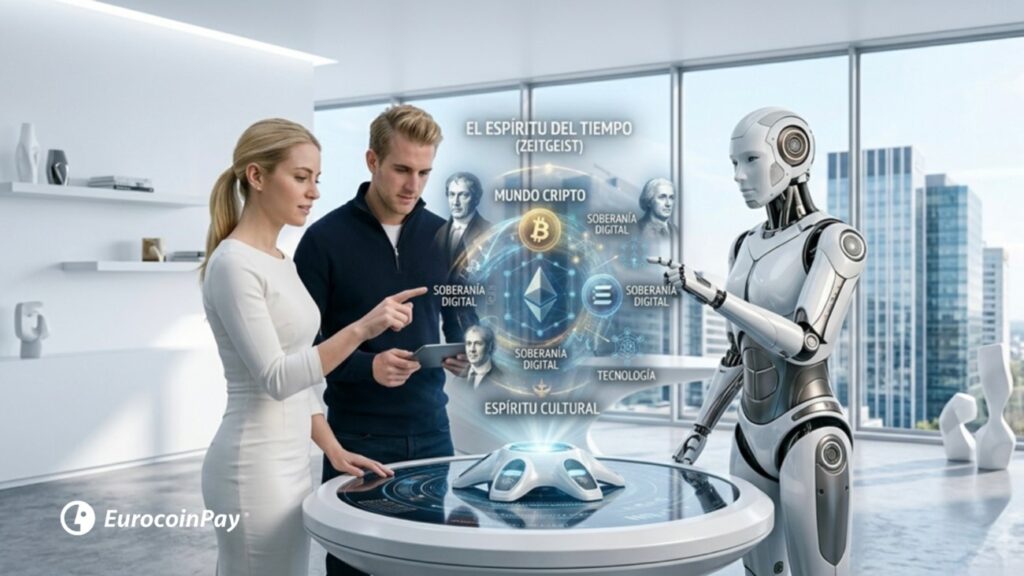
Before we talk about algorithms and decentralisation, we must look back. The word Zeitgeist is not a modern marketing term; it is a legacy of German idealism. Coined by philosophers such as Herder and popularised by Hegel, it literally translates as the ‘spirit of the times’.
The Zeitgeist is that invisible force which causes, at a given time, millions of people who do not know one another to begin to think, feel and act in similar ways. It is the ‘mental climate’ of an era. It is not just fashion; it is the scale of values, the collective fears and the aspirations that define a generation.
If the 20th century was the spirit of mass production and large nation-states, the 21st century has given birth to a Zeitgeist of fragmentation, institutional mistrust and digital sovereignty.
The Transition: From Social Discontent to the Cryptographic Solution
How did we move from philosophy to Bitcoin? The answer lies in the crisis of trust. The Zeitgeist of the last two decades has been marked by a sense of ‘systemic failure’. Financial crises, the loss of privacy and the control of Big Tech created a breeding ground where the spirit of the age cried out for an alternative.
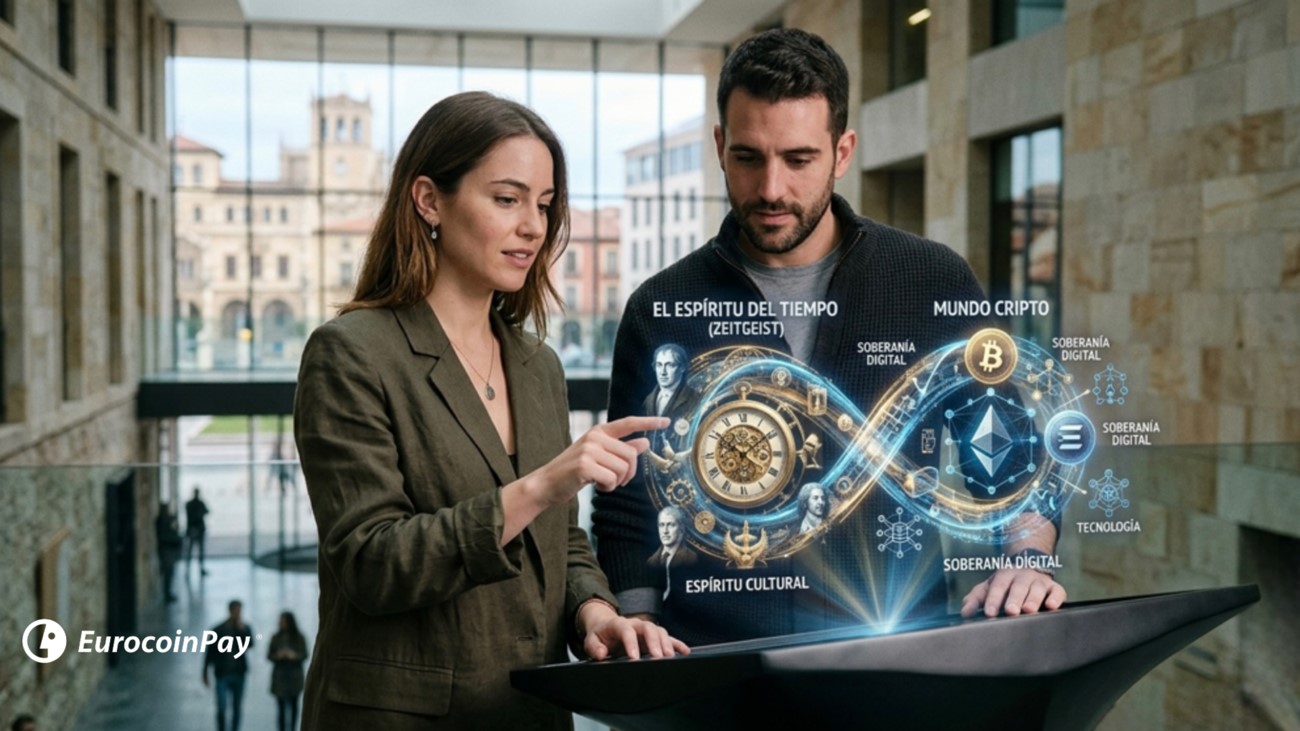
This is where the symbiosis occurs . The crypto world was not born in a technological vacuum; it was born as the technical response to a metaphysical sentiment. Satoshi Nakamoto did not merely programme a protocol; he captured the Zeitgeist of autonomy.
Crypto as the Mirror of Our Age
Today, the symbiosis between the Zeitgeist phenomenon and the crypto ecosystem manifests itself in three fundamental pillars:
1. Decentralisation as the New Morality
If the current Zeitgeist rejects opaque hierarchies, blockchain is its cathedral. The idea that ‘code is law’ replaces faith in human intermediaries. We no longer trust a banker’s signature; we trust a smart contract that is auditable by all.
2. The Meme Economy and Cultural Value
Nothing defines the spirit of 2026 better than the speed of information. Memecoins and community-driven assets are proof that the Zeitgeist has transformed the concept of ‘value’. It is no longer just about economic fundamentals, but about attention and narrative. If a community decides something has value, it does. It is the democratisation — and sometimes the chaos — of wealth.
3. Identity and Sovereign Ownership
We live in an era where we spend more time in digital environments than physical ones. The Zeitgeist of fluid identity finds its means of expression in NFTs and decentralised identities. In the crypto world, you own your assets and your digital footprint, a direct response to collective anxiety over mass surveillance.
The Psychological Engine: FOMO as the Energy of the Zeitgeist
If decentralisation is the backbone of this movement, FOMO (fear of missing out) is its nervous system. At no other time in history has the sense of urgency been so palpable.
The Zeitgeist of 2026 is marked by hyper-acceleration. Thanks to social media and real-time information, we see stories of financial success (and failure) every second. This creates a unique collective pressure: the feeling that the ‘train of history’ is passing by, and it is digital.
- The democratisation of anxiety: Previously, major investment opportunities were reserved for the Wall Street elite. Today, the zeitgeist dictates that anyone with a smartphone can participate. This creates a symbiosis where the value of a crypto asset rises not only because of its technology, but because of the collective desire not to be the last to join.
- Social validation: Owning a certain token or belonging to a specific crypto community has become a symbol of cultural status. It is no longer just about money; it is a sign that you “understand where the world is heading”.
“FOMO is the emotional manifestation of a Zeitgeist that moves faster than our ability to process it”
Conclusion: The Code is the Spirit of Today
The Zeitgeist phenomenon is always seeking an outlet. In the past, it was industrial revolutions or artistic movements; today, that spirit has been encoded in the blockchain.
Crypto is not just a financial investment; it is the technical manifesto of our age. It is the modern human’s attempt to build an order that does not depend on the goodwill of others, but on the certainty of mathematics. Understanding the crypto world is, ultimately, understanding the pulse of our own contemporary history.
Writing about the Zeitgeist and the crypto world is, in essence, documenting a silent revolution taking place on servers and in digital wallets. We are not merely facing a new asset class, but a new way of understanding freedom and ownership.
Disclaimer: The information set forth herein should not be taken as financial advice or investment recommendation. All investments and trading involve risk and it is the responsibility of each individual to do his or her due diligence before making a decision.