Will cryptography be our final ‘Certificate of Humanity’?
Our relationship with visual evidence has changed, and what we once took for granted now requires us to be cautious. We can no longer trust what we see.
This lack of visual reliability and the inability to distinguish the real from the artificial breeds mistrust, insecurity and credibility issues, leading to mental and emotional fatigue, as we feel the need to verify almost everything.
1º.- The decline of eyewitness testimony: 2026 and the collapse of ‘seeing is believing’
As we look ahead to 2026, we face one of the most profound ruptures in the history of human perception: the ontological collapse of trust. For millennia, the phrase ‘I saw it with my own eyes’ represented the ultimate frontier of truth. Today, that certainty has been dismantled by generative Artificial Intelligence, which has ceased to be a tool and become an architect of parallel realities. In this ecosystem of cloned identities and synthetic voices that replicate even the slightest emotional nuance, cryptography has undergone a fundamental metamorphosis. It is no longer about protecting financial assets or securing transactions; today, cryptography is the technological mediation of truth and our only defence to protect reality itself.
2º.- The erosion of the bond: Living in the era of total ‘Deepfake’
We are witnessing a crisis of authenticity where traditional social and banking infrastructure has become obsolete. The risk of synthetic identities has shifted from being a technical dystopia to an everyday existential threat. A video call from a partner requesting an urgent transfer or a voice note from a child imploring for help are no longer proof of human presence; they are, all too often, algorithms fed by the digital trail of our social media.
In this chaos, blockchain emerges not as a ledger, but as a layer of existential verification. Our perception of reality no longer depends on the senses, but on a mathematical structure capable of distinguishing the human from the simulated. Without this network, trust dissolves into an ocean of digital mirages, leaving the individual isolated in a world where nothing that is perceived is necessarily true.
3º.- The ‘Digital Soul’: From public biometrics to private keys in hardware
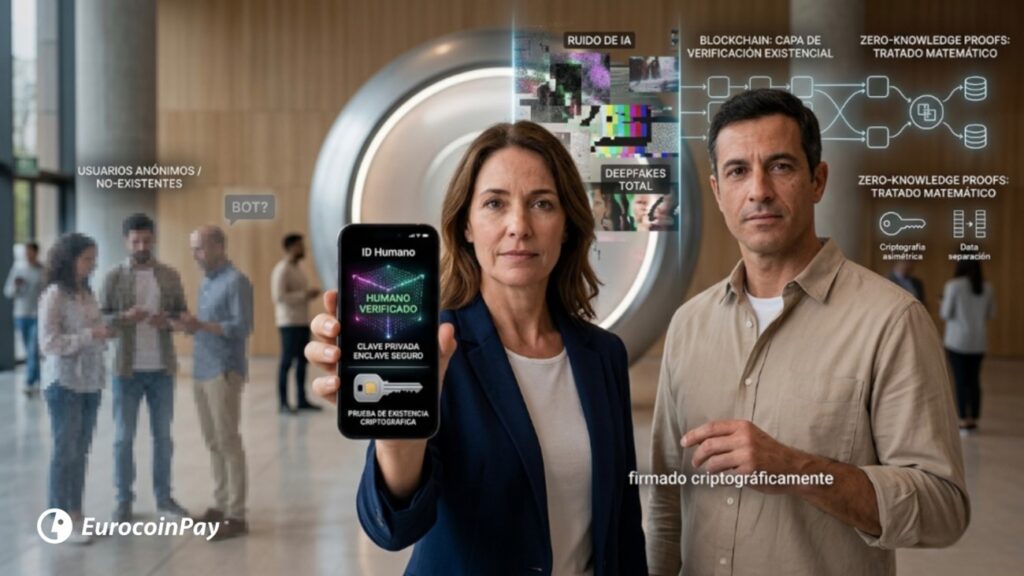
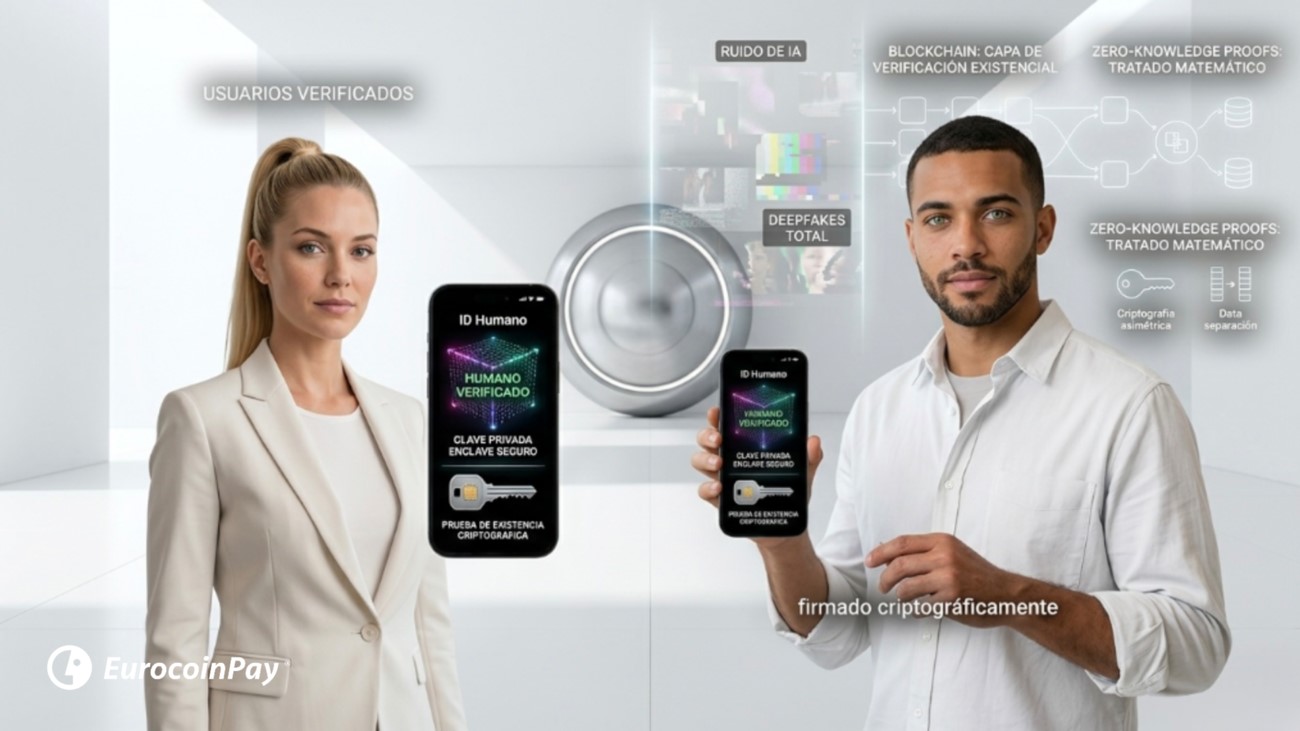
The paradigm of identity has taken a radical turn. Historically, we have relied on biometrics—our face, our fingerprint—as the definitive seal of the ‘self’. However, by 2026, the body has become a sort of ‘public key’: any sensor or camera can capture our image and allow an AI to replicate it infinitely. Biometrics is no longer a secret; it is exposed data. Therefore, the answer lies in asymmetric cryptography and the linking of a ‘Human ID’ to a private key held in a secure hardware enclave.
‘In this near future, if a communication is not cryptographically signed from a verified human node, it will simply be considered “AI noise” or synthetic spam.’
This paradigm shift forces us to move from validating “who I am” (observable biometrics) to validating “what I possess” (a secret and inalienable key). The Human ID must reside on an inviolable physical device to prevent the secret from being duplicated by the software itself, making our private key the sole ‘digital soul’ capable of authenticating our existence within the data stream.
4º.- The ‘Orb’ Dilemma and the Rise of Digital Apartheid
Projects such as Worldcoin have brought to the fore the tension between the need for verification and the fundamental right to privacy. The ‘Orbe’ is presented as the physical guardian of reality, an iris scanner that acts as a tollgate for entry into the trust economy. This friction is cementing a ‘Digital Apartheid’, a systemic segregation that divides society into two categories of existence:
- Verified Users: Those who have surrendered their biometric data to obtain cryptographic proof of humanity. They are the only valid participants, citizens entitled to interaction and digital credit.
- Anonymous Users: Individuals who, out of conviction or lack of access, refuse verification. By 2026, ‘Anonymous’ becomes synonymous with ‘Non-Existent’. They are treated as suspected AI bots, effectively exiled from the digital ecosystem and consigned to oblivion by algorithmic spam filters.
5º.- Zero-Knowledge Proofs: The Mathematical Treaty of Freedom
Faced with the threat of total surveillance under the pretext of verification, Zero-Knowledge Proofs (ZKPs) present themselves as the most elegant technical and philosophical solution. ZKPs make it possible to demonstrate essential attributes — such as being a unique human being or having reached the age of majority — without revealing one’s real identity or handing over personal data.
For a digital strategist, ZKPs are not merely a function; they are the only mathematical treatise that enables the viability of a functional society without succumbing to the absolute panopticon. It is the ability to say ‘I am human’ to the protocol without the protocol knowing my name. In 2026, privacy is not a luxury; it is a functional requirement for freedom in a world of constant algorithmic surveillance.
6º.- Conclusion: Blockchain as the species’ last refuge
It is a historical paradox that the technology born to eliminate banking intermediaries is today the only one capable of saving the essence of our species. In an ocean of infinite machine-generated content, blockchain acts as the lighthouse that separates the real from the simulated. Our private key is no longer simply a key to a digital wallet; it is now the existential mechanism that shouts to the world: ‘I exist, I am flesh and blood, and this message is mine’.
Cryptography is our last line of defence against digital irrelevance. In a world where your face is a lie and your voice is a ghost, the future poses an inescapable question:
Are you willing to surrender your privacy to a mathematical record so as not to be erased from human reality?
Disclaimer: The information set forth herein should not be taken as financial advice or investment recommendation. All investments and trading involve risk and it is the responsibility of each individual to do his or her due diligence before making a decision.
Original images from EurocoinPay, designed by humans using artificial intelligence.
This article was written using a combination of human and AI-generated content.