The Paradox of Bitcoin
Why do we invest more when we trust less?
On the European Union’s economic chessboard, the pieces do not move according to the same logic in Berlin as they do in Madrid. Whilst in the northern capitals, savings are sheltered in pension funds and sovereign bonds, in the south (and very specifically in Spain) a phenomenon has emerged that defies financial orthodoxy: the adoption of crypto-assets as a defence mechanism against the country’s economic management.
Investing for luxury vs. Investing out of necessity
It is often thought that cryptocurrencies are a toy for the wealthiest countries. Data from 2026 disproves this theory. If we look at total volume, Germany and France dominate the market thanks to their large institutions. However, if we analyse retail adoption, Spain consistently ranks above its northern neighbours. So, what is the reason? The Institutional Distrust Effect.
In countries with rock-solid political stability and a currency perceived as infallible, the incentive to ‘step outside the system’ is low. In Spain, where public debt remains a structural challenge and the tax burden on savings is growing, the average citizen has stopped viewing Bitcoin as an exotic asset and now sees it as a form of financial life insurance.
The socio-economic ‘sandwich’ in Spain
Spain finds itself in a unique situation in Europe. We are not a failed economy, but neither do we enjoy the security of Central European savings. This has created three investment profiles driven by the country’s reality:
- The ‘Brickless’ Youth: For the under-35s, accessing home ownership is almost a pipe dream. Unable to invest in property (the traditional Spanish safe haven), young people have channelled their capital into digital assets. For them, the risk of crypto volatility is preferable to the risk of financial irrelevance.
- The Reaction to Tax Pressurel: Spain has led the way in implementing control regulations (such as Forms 172, 173 and 721 and the exhaustive monitoring by the AEAT). Far from discouraging use, this aggressive taxation has professionalised the Spanish investor, who now actively seeks knowledge about self-custody and decentralised finance (DeFi) to maintain real control over their wealth.
- The MiCA Effect: With the full implementation of the MiCA law in 2026, traditional Spanish banks have had to give in. Today, seeing major national institutions offering BTC custody is not a sign that the system has won, but that the public has forced the system to adapt.
Does poorer economic management mean more crypto?
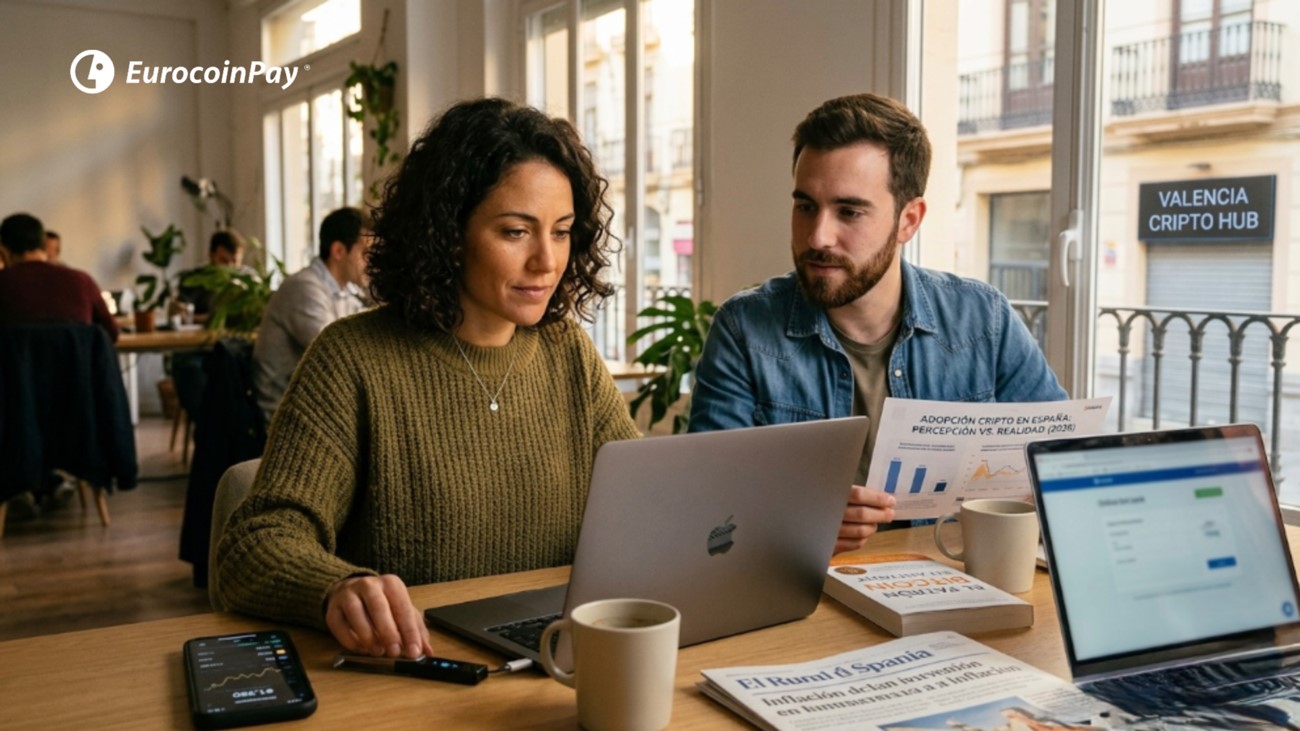
The correlation is fascinating. The data suggests that in regions where the perception of public management is negative (as measured by institutional trust indices), the adoption of stablecoins and Bitcoin increases. In Spain, the use of crypto-assets has served as a silent vote of no confidence.
Unlike countries such as Switzerland, where the franc is sacrosanct, Spanish investors have learnt the hard way (the 2008 crisis, post-pandemic inflation) that the value of their savings depends on political decisions that often do not work in their favour. Cryptocurrencies, therefore, act as an ‘escape valve’ from the government of the day.
Conclusion
Spain does not invest in crypto because it is a ‘poor’ country, but because it is a country with a middle class that feels unprotected. As long as politics remains a source of uncertainty, digital gold will continue to gain ground against the euro in the collective imagination of Spaniards.
By 2026, Bitcoin is no longer a casino gamble on Gran Vía; it is the fortress that many have built to protect themselves from what is decided in government offices.
Disclaimer: The information set forth herein should not be taken as financial advice or investment recommendation. All investments and trading involve risk and it is the responsibility of each individual to do his or her due diligence before making a decision.
Original images from EurocoinPay, designed by humans using artificial intelligence.
This article was written using a combination of human and AI-generated content.