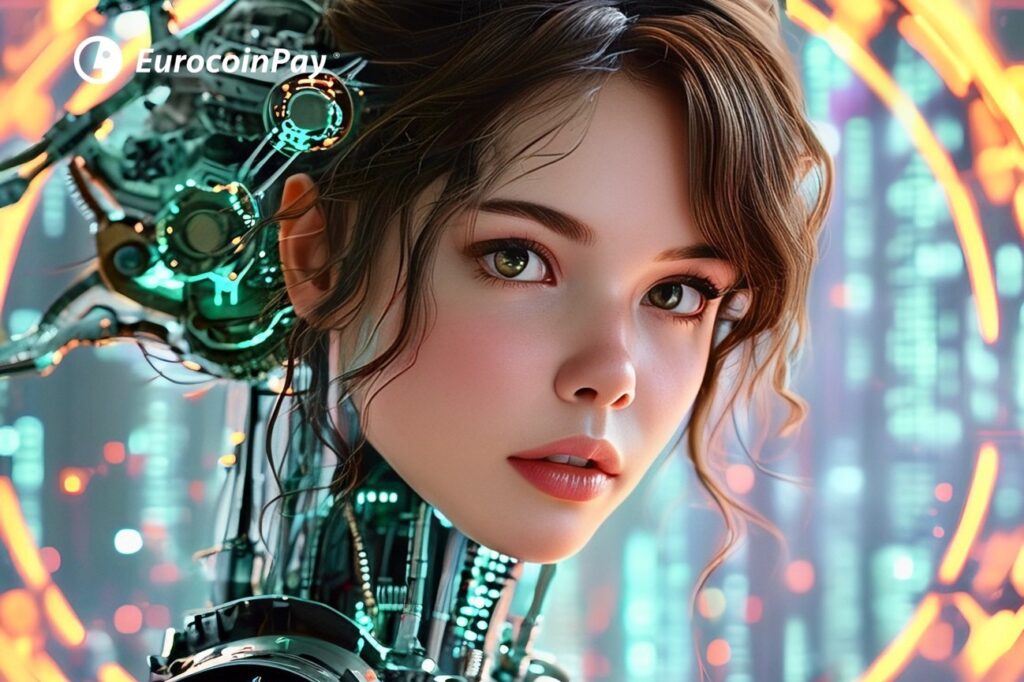
Cryptocurrencies & AI
The growth and penetration of artificial intelligence (AI) in all sectors, including cryptocurrencies, is astonishing. According to a study by IBM Research, AI could accelerate Bitcoin transactions by up to 90%.
Blockchain technology and AI have revolutionised the digital ecosystem, and the synergy between the two helps to improve confidence in data integrity, as explained by IBM experts.
‘Using blockchain to store and distribute AI models provides an audit trail, and the combination of blockchain and AI can improve data security’
AI can extract valuable insights from large volumes of data in real time, while blockchain technology stores the data, creating encrypted and completely secure databases.
Combining blockchain technology with artificial intelligence can create a perfect system for storing backups of sensitive and high-value personal information.
What are artificial intelligence coins?
Artificial intelligence (AI) coins refer to digital tokens or cryptocurrencies that combine the power of artificial intelligence with the decentralisation and security of blockchain technology. They are designed to improve blockchain operations, personalise user experiences, or facilitate automated trading.
Unlike traditional cryptocurrencies, which rely solely on mathematical algorithms and consensus mechanisms, AI cryptocurrencies integrate technologies to improve performance, optimise transactions, and enable autonomous decision-making.
Top AI & Big Data Tokens by Market Capitalisation
(Source: CoinMarketCap – 4 December 2025)
| LOGO | CRYPTOCURRENCY | SYMBOL |
|---|---|---|
 | Bittensor | TAO |
 | NEAR Protocol | NEAR |
 | Internet Computer | ICP |
 | Filecoin | FIL |
 | Render | RENDER |
 | Story | IP |
 | Virtuals Protocol | VIRTUAL |
 | Injective | INJ |
 | Artificial Superintelligence Alliance | FET |
 | The Graph | GRT |
Differences from other cryptocurrencies
AI cryptocurrencies differ from traditional ones in the following ways:
- They do not require a central authority
AI is being used to create decentralised algorithms capable of making decisions about the network. This eliminates the need for a central authority and makes the network more resistant to manipulation and fraud.
- Automation of operations and portfolio management
AI is also used to automate tasks that traditionally require human intervention, such as executing trades, managing portfolios, and detecting fraud.
- Adaptability to market changes through machine learning
AI algorithms created for cryptocurrencies are capable of learning and adapting very quickly to changing market conditions.
- Advanced security against fraud and cyberattacks
Through intrusion detection, fraud modeling, and protection against cyberattacks, AI has become almost essential to the security of large-scale projects, making the entire industry increasingly reliable, transparent, and secure for investors.
- Scalability and transaction efficiency
Much faster processing and a higher volume of transactions is one of the goals, and this is being achieved in several projects.
- Personalization of services and user experience
With the combination of both technologies, the user experience can be precisely personalized and services tailored to individual needs can be offered.
Benefits
Among the benefits of artificial intelligence cryptocurrencies are:
- High growth potential.
- They provide real solutions with benefits that users can take advantage of.
- They have a large number of intelligent automation features.
- Decentralized markets where you can sell or share data to train AI models.
- Integration with Web3 tools. AI is a key component of the next generation of the Internet.
In short, greater security, efficiency, smarter decision-making, more efficient markets, new products and services, and democratized access
Risks
Artificial intelligence cryptocurrencies serve innovative platforms, but they carry significant risks:
- Developing technology: The technology is still new, and many projects are experimental. That means you could invest in something that fails or never launches.
- Volatility: Price volatility is another major challenge. AI tokens often fluctuate wildly in value due to hype, low liquidity, or unclear roadmaps. This can lead to big losses for beginners.
- Technical complexity: Technical complexity also plays a role. Many projects require in-depth knowledge of both blockchain and machine learning. If you don’t understand how decentralized AI markets work, you could misuse the platform or fall victim to scams.
- Regulation: Furthermore, regulation is still unclear. Governments have not decided how to manage the tokens that power AI services. This adds uncertainty for investors and developers.
Is AI the future of cryptocurrencies?
The integration of AI is transforming the crypto ecosystem, with automated trading, predictive analytics, and greater transparency. Although there are risks, the potential for growth is enormous.
As of today, there is no official artificial intelligence cryptocurrency, however, there are numerous cryptos that use AI to enhance their proposals and tokens. In this way, they have managed to innovate and solve real-life use cases.
After analyzing different artificial intelligence cryptocurrencies, as well as their characteristics, usefulness, and potential applications, there is no doubt that these are assets that are changing the way we interact with the world of finance. This not only impacts the forecast for Bitcoin or ETH, but also that of the entire crypto market ecosystem.
Likewise, we have seen how cryptocurrency wallets that integrate with artificial intelligence make transactions more effective and secure. The convergence between blockchain and AI has opened the door to a new vision in the digital financial system
Recommendations
If you want to invest in AI-related cryptocurrencies this month, you need to follow these strategies:
- Target projects with real utility: this is one of the most solid ways to ensure that your investment will hold up over time.
- Avoid scams: projects that only promise to ‘revolutionise AI’ without functional products.
- Look for projects where the token has well-known corporate partners and a stable, active community.
- Do not invest in projects without relevant partners or with a community focused solely on price.
- Diversify your portfolio: do not put all your money into a single token.
- Buy on dips: keep in mind that if a token falls +20% without fundamental reason, it may be an opportunity.
- HODL for the long term: AI in blockchain is a trend that will last for about 5 to 10 years.
Conclusion
The convergence of blockchain technology and artificial intelligence (AI) has given rise to numerous AI-driven cryptography projects that aim to deliver secure and efficient solutions within blockchain protocols.
However, these projects face challenges such as understanding their complexities and navigating uncertain regulatory environments. Each AI-powered project has different purposes, from improving cloud computing services to enabling secure data exchange. Cryptocurrency investors should conduct thorough research before investing in these tokens to make well-informed decisions. We recommend approaching this new niche market with background information, a diversification approach, and reasonable risk tolerance.
To choose the best projects, check the development team and verify that they are developers with experience in AI and blockchain.
Projects with partners such as Google, Nvidia or large companies are more likely to succeed. It is true that you will not always find projects associated with these large companies, but any links to them are a guarantee of security and quality.
The future of AI in the crypto world is bright, but its development must be guided by principles of responsibility, ethics, and transparency to ensure a positive and lasting impact on the industry and society at large.
Disclaimer: The information set forth herein should not be taken as financial advice or investment recommendation. All investments and trading involve risk and it is the responsibility of each individual to do his or her due diligence before making a decision.
Original images from EurocoinPay, designed by humans using artificial intelligence.
This article was written using a combination of human and AI-generated content.